Watch it Grow
‘Jesus asked, “What is God’s kingdom like? To what can I compare it? It’s like a mustard seed that someone took and planted in a garden. It grew and developed into a tree and the birds in the sky nested in its branches.” (Luke 13:18)
The parable of the mustard seed appears in all three Synoptic Gospels, with each writer placing it within their own distinct narrative setting.
In Matthew, it stands among a series of parables that reveal the diverse dimensions of the kingdom of God.
In Mark, our parable is preceded by his broader reflection on using the imagery of seeds to represent the spreading and growth of God’s word, beginning with the parable of the sower scattering seed that represents God’s word, then he offers a brief reminder that the growth ultimately comes from the power of God, and then he recites the parable of the mustard seed.
In both Matthew and Luke, this parable is immediately followed by another similar parable, the parable of the leavened flour, and that placement doesn't seem unintentional: the imagery in each story deepens and complements the meaning of the other. In Luke 13:20 and that second parable reads this way,
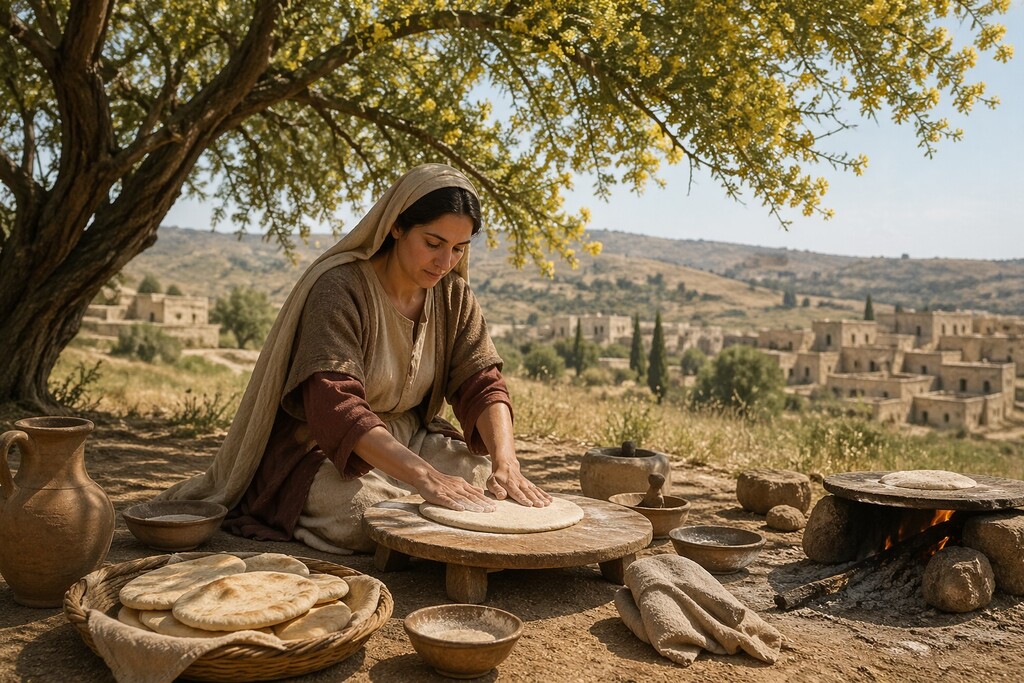
“To what shall I compare the kingdom of God? It is like leaven that a woman took and hid in three measures of flour, until it was all leavened.’”
From my perspective, the parabolic symbolism seems evident in both stories, Jesus is asking, what shall I compare the kingdom of God to? Then he chooses images that begin in the most minute form, before manifesting into something far greater. Just about every place in the gospels when Jesus is referring to the kingdom of God, the implication is, that it is something spacious, expansive and inclusive.
I can also see how the symbolism could point to the purpose of his original mission, that both the seed and the leaven could be representing him.
He became the seed planted among the people, and faith in him began to take root in the hearts of the those who heard his message and grew into a community of believers.
His unconditional love worked like leaven in the hearts of those he touched, quietly transforming them from within. It’s that same love that’s the underlying and essential force of the kingdom of God, and that same power is currently driving its unfolding as it becomes a living reality.
“Your kingdom come, your will be done, on earth as it is in heaven.” (Matthew 6:10)
Part One
Jesus was a Jewish Rabbi and almost everything he taught to his Jewish disciples were sprinkled with phrases and references to the Old Testament scriptures, places in the scriptures where they could go and study to find deeper meanings to his teachings.
So when they heard him say “a tree where the birds can nest in its branches,” it should have almost immediately stirred their memory, recalling words from the great prophet Ezekiel’s writings.
There is a parable in the book of Ezekiel in chapter 17, where the prophet tells a short story about restoration, using a tree and two eagles, the short version is they are plucking twigs off a cedar tree (our parable says the mustard seed grows into a tree) and then the eagles are planting them, representing two kingdoms, Babylon and Egypt.
In the story the people of Judah hoped one kingdom might rescue them from the bondage imposed by the other (Egypt recusing them from Babylon). But their captivity had been permitted by God as a consequence of their unfaithfulness, so their attempt to escape it through some diplomatic coalition was destined to fail and ultimately did.
But the Ezekiel goes on in verse 23 to promise restoration in the second part of the parable, that one day God Himself would plant his own twig or seed and raise up His own cedar tree (representing his restored kingdom). This tree would become a place of rest and refuge for many nations, (the birds) and Ezekiel wrote,
“On Israel’s mountainous highlands I will plant it, and it will send out branches and bear fruit. It will grow into a mighty cedar. Birds of every kind will nest in it and find shelter in the shade of its branches.”
With that prophetic parable in mind, Jesus’ parable of the mustard seed should have immediately drawn his disciples back to Ezekiel’s promise of restoration and renewal, and hopefully they realized that Jesus stood right before them as the fulfillment of that long‑awaited vision
Part Two
In the parable of the leavened flour, some interpreters contend that the leaven symbolizes the corrupting influence of the Pharisees’ teachings infiltrating the kingdom, and that may well be. They use as support of that argument, by stating the parable states the woman “hid” the leaven in the flour, as though she placed it quietly and deceptively, reinforcing the idea of a subtle, insidious spread.
It’s true that Jesus warned his disciples repeatedly about the danger of Pharisaic doctrine, and he did used leaven as a metaphor for its subtle, pervasive influence.
In Matthew 16:12 the writer explains his disciples finally grasped the message Jesus was trying to get through to them, when he wrote, ‘Then they understood that he wasn’t telling them to be on their guard for leaven used in making bread. No, he was telling them to watch out for the teaching of the Pharisees and Sadducees.’
However, in our parable the word ‘hid’ doesn’t necessarily imply a deceptive or stealthy act.
Let me explain, in Matthew 5:14, when Jesus says that a lamp on a hill “cannot be hid,” the Greek word used there for ‘hid’ is kryptō, which carries the sense of concealing or hiding something.
But in the parable of the leaven, the word used for ‘hid’ is enkryptō, this variance adds a different nuance, now its meaning is less about secret concealment and more about mixing in, embedding, or combining something within something else.
Jesus was clear when he told his disciples to understand that the word leaven, in that parable and in that context, was a warning:
The influence of the Pharisees was already spreading through the people like leaven through dough, shaping their thinking in subtle but harmful ways. He urged the disciples to stay alert so that this “leaven” would not take root in their own minds or shape their understanding without them realizing it.
But I still don’t think that’s quite the case with our parable, I could be wrong, or it could mean both, parable are deep and layered with meaning, but it seems far more likely that the leaven here symbolizes his teaching, not the Pharisees', and it’s his words, not theirs, powerful and transformative, they are the leaven that will permeate the hearts of those who hear them.
In the same way, the mustard seed begins as something small and seemingly insignificant, the leaven as a tiny, almost undetectable grain, yet both grow into something expansive and beneficial, quite a transformation.
Interesting Observation
Now, regarding the phrase “three measures of flour,” these are exactly the kind of details that fascinates me when I’m studying and researching for these short reflections. There’s a principle among religious scholars in biblical study, almost universally recognized, that’s called the “rule of first usage.” The idea is simple: when a word or phrase appears multiple times in Scripture, you return to its first appearance, try and understand its original usage and circumstances, and let that meaning and context guide its later applications.
If we follow that principle and go back to Genesis 18, we find the earliest mention of the phrase “three measures of flour,” and it comes in a story when the three visitors, two angels and the Lord, approach Abraham as he was resting under a tree. After greeting and welcoming them, he invites them to dinner and he asked his wife Sarah to prepare a meal for them, and part of that request was to use “three measures of flour” to prepare the bread.
Now I'm not sure if he intended his disciples to recall this story merely for its gesture of hospitality, though that has meaning, the scene carried the much deeper significance of sacred fellowship, almost a prototype of communion shared in the presence of God, perhaps even a kind of first supper.
But to me, what makes this event even more fascinating is they came to announce to Abraham, that his wife Sarah, (the “woman who used three measures of flour”) would bear a son. And it would be through that promised child, the lineage of Jesus would eventually unfold.
It is amazing and remarkable that Jesus, in telling such a brief parable, could draw his disciples back to the very foundation of the original promise he came to fulfill, I truly wonder if they got it?
Conclusion
Seriously contemplate this: Jesus tells a parable that reaches back to a pivotal moment near the beginning of biblical history, when He appeared to Abraham and informed him that his wife Sarah would bear a child. And through that child’s lineage, He himself would eventually be born as the promised Messiah and enter the world as its savior.
‘For as the earth brings forth its sprouts, and as a garden causes the things sown in it to spring up, So the Lord God will cause righteousness and praise to spring up before all the nations.’ (Isaiah 61:11)