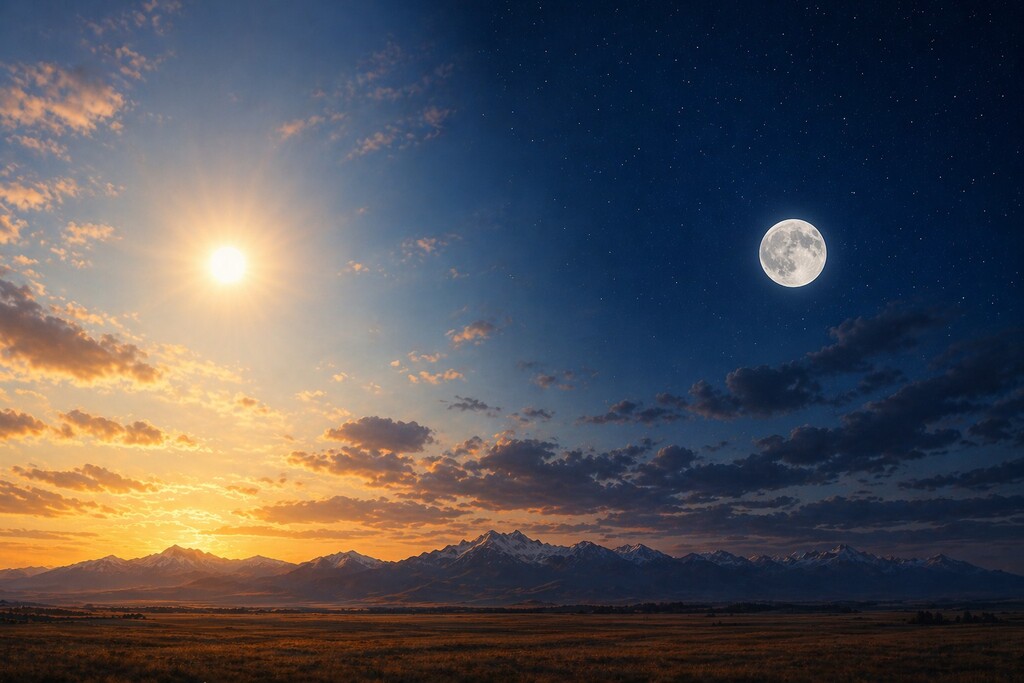
Sun and the Moon
I heard someone say the moon and the sun look like they are the exact same size.
‘God made the two great lights, the greater light to rule the day, and the lesser light to rule the night; He made the stars also’ (Genesis 1:16)
As someone who is open to the idea that life in the universe may exist beyond our own world, I found the observation astonishing, It actually may lend weight to the idea that life on Earth may exist in relative solitude and I’ll explain why.
Is it possible that God shaped the universe as a kind of vast support system for Earth and the life placed upon it? Could the stars themselves exist for His purposes, woven into creation with intention? And is the night sky meant to function as a sort of divine message board, a place where God communicates certain proclamations across every realm?
‘Heaven is declaring God’s glory; the sky is proclaiming his handiwork.’ (Psalms 19:1)
‘He determines the number of the stars and calls them each by name.’ (Psalms 147:4)
Of course, I believe God speaks to us primarily through His Word in this era, not the sky; Even so, we must recognize that every now and then He has provided symbolic revelations in the firmament for his own purpose.
‘I have set my rainbow in the clouds, and it will be the sign of the covenant between me and the earth.’ (Genesis 9:13)
Where is the one who has been born king of the Jews? We saw his star when it rose and have come to worship him.’ (Matthew 2:2)
But if there is not life on other planets, then what influence is His planetary creation is meant to have on humanity, surely there's a purpose behind its existence in general.
In Deuteronomy, it’s stated that the heavens were made for all the people on earth, yet not for every purpose. God specifically warned us not to try to read signs in the stars or other celestial bodies, even worse, to worship them. So while the heavens serve humanity, they are not meant to become objects of spiritual guidance.
‘Don’t look to the skies, to the sun or the moon or the stars, all the heavenly bodies, and be led astray, worshiping and serving them. The LORD your God has granted these things to all the nations who live under heaven’ (Deuteronomy 4:19)
It’s hard to speak with absolute certainty, but when you look at the earth itself, its structure, its balance, its beauty, it’s difficult to argue that there isn’t intentional thought behind it. Paul makes this point in Romans, emphasizing that creation itself is so plainly expressive of God’s nature that no one can use denial as an excuse for unbelief.
‘Ever since the creation of the world, God’s invisible qualities, God’s eternal power and divine nature, have been clearly seen, because they are understood through the things God has made. So humans are without excuse.’ (Romans 1:20)
But when you look at the the stars and the vastness of the universe, and then compare it to the intricate and amazing details of creation on this planet:
The contrast between the two can make God’s celestial intentions seem less obvious then that of earth’s revelations, even though there are many astronomers who would greatly disagree with that analysis. And Isaiah certainly didn’t see the heavens as meaningless either:
‘Lift up your eyes and look to the heavens: Who created all these? He who brings out the starry host one by one and calls forth each of them by name.’ (Isaiah 40:26)
So, I started wondering whether God might have created such a vast universe partly for its beauty just to be observed by the residence of Earth. Of course, there may also be deeper layers of cosmic order, structures and interactions far beyond my understanding, that are necessary to keep everything aligned so Earth remains secure in its orbit. Any of those relevant astronomic certainties are well above my pay grade, that being said the verse below indicate they are certainly not above God’s.
‘When I look at your heavens, the work of your fingers, the moon and the stars, which you have set in place.’ (Psalm 8:3)
But as I considered the statement that the Sun and the Moon appear the exact same size in our sky, I was somewhat dumbfounded and I thought that’s truly a remarkable kind of alignment.
So, I did a little bit of digging online (as one does), and here’s what I found when I asked the question to Yahoo's AI platform. Pay attention to the words I highlighted in bold, it raises the question: is this just coincidence, or is something deeper at work?
The Sun is approximately 400 times wider than the Moon. Despite this significant difference in actual size, they appear identical in our sky due to their distances from Earth. The Sun is also about 400 times farther away from Earth than the Moon is.
The Moon orbits Earth at an average distance of about 384,400 kilometers (238,855 miles). Meanwhile, the Sun is vastly more distant, averaging around 150 million kilometers (93 million miles) from Earth. This precise ratio of size to distance creates what is known as similar angular size.
Angular size refers to how large an object appears from a specific viewing point. Because the Sun’s greater size is almost perfectly offset by its much greater distance, both the Sun and the Moon subtend roughly half a degree in our sky. This rare alignment allows for phenomena like total solar eclipses, where the Moon can perfectly obscure the Sun’s disk.
All of this sounds scientific and I'm sure is well‑established, but what I really want to know is: what are the odds? How likely is it, truly, that two objects of vastly different sizes, sitting at unimaginable different distances from Earth, yet they would somehow line up in such a way that they appear exactly the same size to anyone looking in the sky? So exact, in fact, that one can pass in front of the other and cover it completely, cleanly, and precisely. Astronomically, what's the odds?
Are these the two lights God placed in the sky in Genesis
I’m not sure whether there’s life on other planets in the universe, and I don’t see the scriptures taking an absolutely definitive stance on the question either way. So the possibility remains open.
Are we the only ones in this vast cosmos, and was everything created to support this planet and its inhabitants?
I just heard my own argument suggesting that might be the case, and I have to admit, it was fairly reasonable.